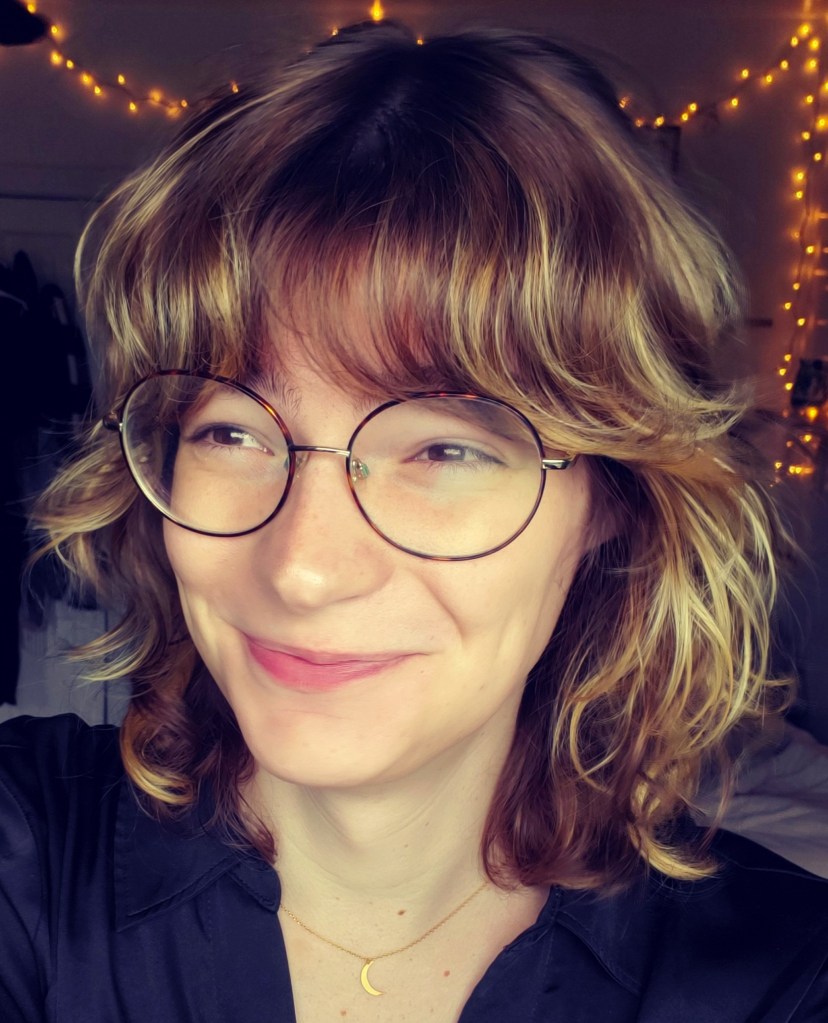
Juniper Clark (she/it)
I am a Philadelphia-based researcher, sound artist, and PhD student in Music Studies at the University of Pennsylvania. Drawing from a range of methodologies and disciplinary inclinations around sound, voice, and animal studies, my research and creative practice interrogates normative constructions of “animality” as it comes to be articulated and rehearsed through emergent forms of media, discourse, and performance. My current work, across speculative-theoretical and ethnographic projects, attempts to trace configurations of transspecies intimacy across a contemporary terrain upon which the terms of human-nonhuman relationality are increasingly mediated by technologies of distancing, obfuscation, and abstraction.
This site is currently under construction – I will be slowly filling out these pages with more info about myself and the work I do in the coming months. Thanks for your patience in the meantime!
voice // power // coloniality // activism // community
Broadly (tentatively!), I tend to theorize my work as constellations of questions, which tend to be more-or-less grouped into three obliquely related spheres. The first of these emerges directly from my ongoing involvement with nonhuman activist initiatives and is concerned centrally with how the nonhuman voice is deployed (both generatively and perniciously) as a tool of advocacy in these movements and communities. Sharing space with recent interventions in postcolonial voice studies and elsewhere that have interrogated how colonial framings of otherized (and “animalized”) human voices have been integral to violent regimes of domination and subjugation, as well as work in critical animal studies, new materialism, Indigenous studies, and political ecology that reminds us to question Western, anthropocentric reductions of political agency to human voice and language, my work in this vein seeks to not only problematize the notion of the “voiceless” nonhuman subject, but also to understand the complex roles listening (as a potential form of attunement, care, and response-ability, but equally an instrument of exoticism, essentialism, and colonialism) plays in communities that seek to dismantle structures of Western human exceptionalism. So, given that the nonhuman voice has been traditionally ignored in scholarly inquiries that take sound to be essential in its affective and exclusionary power, how might we begin to better listen to—and take seriously—those who are rendered speechless under anthropocentric hegemony? And how might such an aural recalibration foster more sensitive multispecies communities and modes of activist performance?
fur // materiality // media // resistance // care // violence
In a second, parallel key, and with the above problematics in mind, I have been drawn recently to two opposing (yet necessarily co-reliant) ethnographic sites: the “exotic” rescue sanctuary and the industrial fur-farm. Following the discourses and media that these sites engender—among others, the uplifting sanctuary vlog, the gruesome fur-farm exposé, the pro-fur internet brochure—I am interested in exploring how vastly different understandings of the nonhuman animal voice (here, construed as the ultimate signifier of subjectivity) play critical roles in the lives and deaths of those at the center of such ecologies. Taking these individuals at their word, and attempting to listen against how these voices normally come to be filtered through human ears, sensoria, and other listening apparatus, I ask, what might a nonhuman archive of resistance sound like? And, at the fur-farm in particular, how might we begin to theorize sound and voice at the edge of death? Not the voice as it comes to be romanticized in “swan song” or the rhythms of psychoanalytic death drives, but as material, radically dialogic, and above all, concerned with the act of living?
gender // performativity // play // intimacy // embodiment
Lastly, I often engage understandings and performances of “animality” as it has come to be entangled with human queerness, and transness in particular. Here, though I am interested in critiquing historical formulations of the queer human subject that characterize such bodies as variously in/non/sub-human to violent, exclusionary ends, I am drawn specifically to initiatives by queer and trans people that actively refuse the human entirely as a viable category of identity, and instead endeavor to align themselves with “animality” as a positive affirmation of difference—sexual or otherwise. Informed by my own experiences as a trans* person involved in internet subcultures wherein the categories trans/queer/animal often have considerable overlap (furry, therian, otherkin, etc.), my preoccupation with these assemblages carries with it an investment in the potential of play and performance to queer the species boundary while at the same time provide a space for personal exploration of gender and identity. For many trans people in these communities especially, to play (as) the nonhuman is to play in spite of the (human) body, a site so often contested on multiple fronts. However, even if for some individuals the recourse to animality is indeed a strategy of survival, where might we locate “living” animals—and not simply species essentializations—in performances of and identifications with “animality”? In other words: when “humans” find their voices under the guise of “the animal,” might this foreclose the possibility of response?
The sites at which I rub up against these questions vary widely — you can find documentation for some of these under the “projects” tab.
 juniper clark